3S Separator Technology – Supersonic Debottlenecking for Gas Processes
3S Separator Technology: Supersonic Debottlenecking for Gas Processes
The 3S Supersonic Separator is a static device that accelerates gas through a convergent–divergent (Laval) nozzle, inducing rapid cooling and condensation. A swirl generator creates high centrifugal forces that throw droplets to the wall, while a diffuser recovers part of the pressure and directs a liquid slip stream to a knock-out vessel. This single, motionless unit delivers pre-condensation, dehydration, and pressure-savvy separation in milliseconds — ideal for debottlenecking existing plants.
Where 3S Unlocks Capacity
- Upstream of cold boxes / J-T stages – pre-remove condensables and water to cut refrigeration duty and reduce recycle gas.
- Hybrid with turbo-expanders – 3S handles bulk condensation; the expander polishes to ultra-low dew points and higher NGL recovery.
- Replace or downsize chemical trains – fewer rotating assets and no solvent regeneration for many duties.
- Brownfield revamps – compact skid modules add throughput without major civil works.
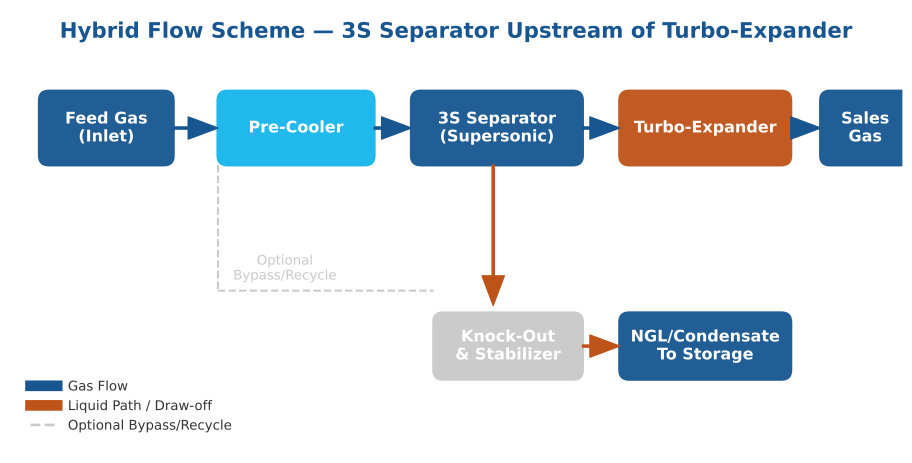
The blue gas path passes through a pre-cooler and 3S unit before expansion; orange shows the liquid slip stream
leading to knock-out and stabilization.
Debottlenecking Impact
In pilot and field tests, 3S modules consistently delivered higher C3+ recovery than J-T valves at the same Δp, while lowering chiller load and recycle.
This translates into more sales gas, deeper hydrocarbon dew point (HCDP), and room in the pressure budget for downstream equipment.
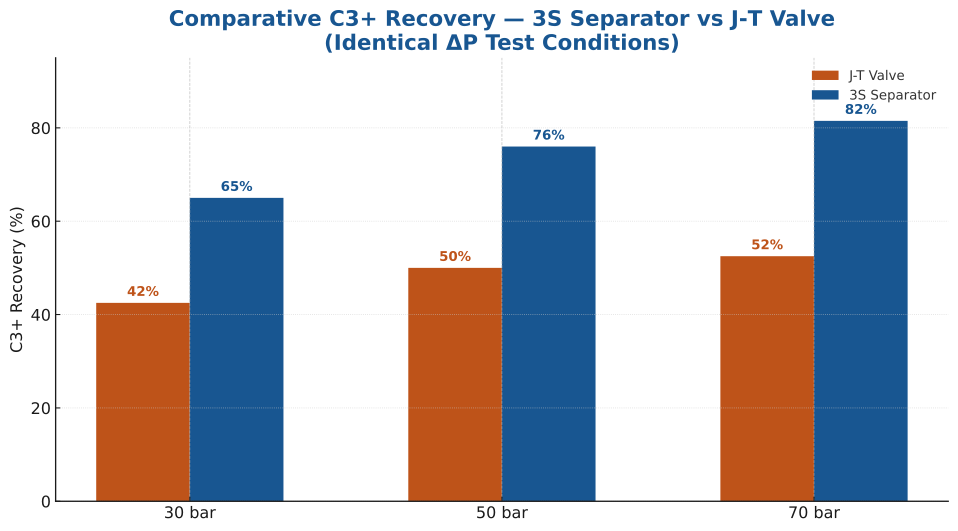
Supersonic separation delivers up to 40% higher recovery and alleviates bottlenecks in refrigeration and expansion stages.
Why 3S Debottlenecks
- Process intensification: cooling, condensation, separation, and pressure recovery occur in one static device.
- Energy-smart: converts part of differential pressure to deep cooling, then recovers pressure in the diffuser.
- Reliability: no moving parts, no chemicals; ideal for remote/offshore and unattended operation.
- CFD-aided design: geometry and swirl are tuned to place shocks stably, maximize droplet capture, and minimize entrainment.
Typical Outcomes in Revamps
- Reduced refrigeration duty in cold boxes; fewer anti-hydrate measures.
- Lower recycle gas and compressor power for the same product specs.
- Deeper HCDP and water dew point; improved NGL yield.
- Skid modularity to add capacity with minimal plot space.
Note: Actual gains depend on gas composition, inlet conditions, target specs, and allowable pressure drop.
3S is commonly applied as an upstream pre-treat step in a hybrid train to maximize efficiency.