Tag Archive for: Supersonic gas separation

Venezuela’s Paraguaná Refining Complex (CRP), which includes the Amuay and Cardón refineries, remains a cornerstone of the country’s energy system. These facilities have opportunity and capacity to process offshore crude while receiving significant volumes of associated gas and natural gas through dedicated pipelines. However, the current gas-handling configuration leaves valuable C3–C4 fractions unrecovered.
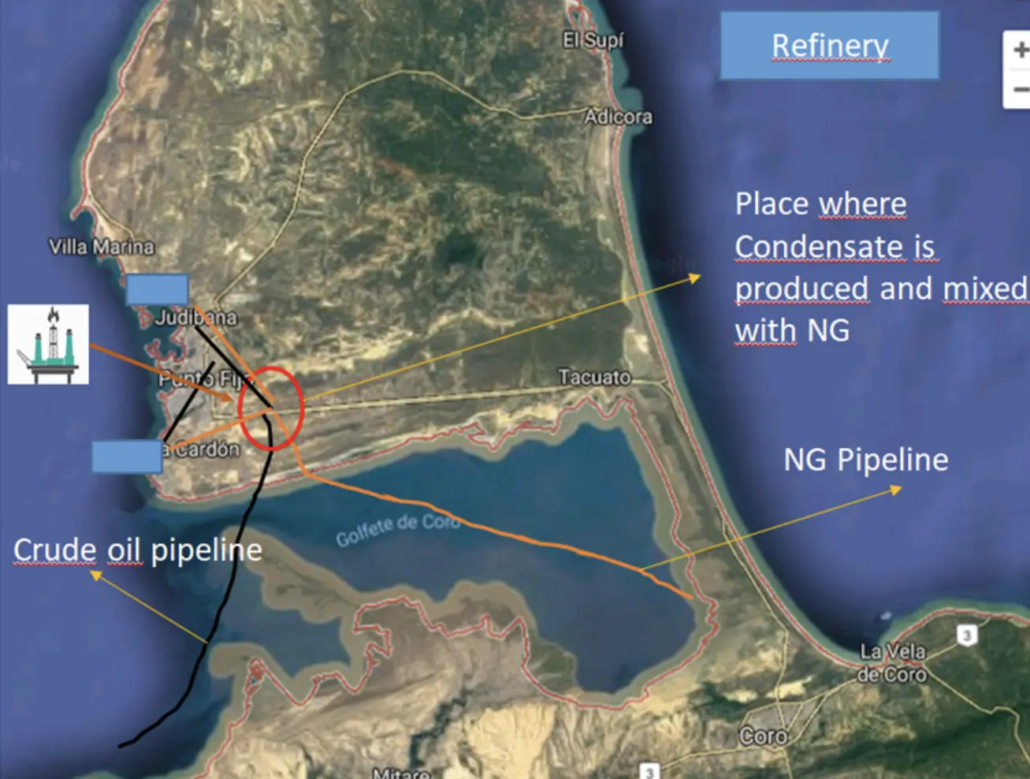
Paraguana Refining Complex 1
Supersonic Gas Separation (3S Technology): A Strategic Opportunity for PDVSA at Amuay and Cardón 3

The implementation of a modern, compact and highly efficient solution — the 3S Supersonic Separation Unit — would offer PDVSA (Petróleos de Venezuela) a unique opportunity to recover these liquids and significantly improve refinery economics.


1. Current Gas Handling at CRP: Lost C3+ Value

After onshore processing, associated gas undergoes only basic condensate separation before being blended with mainland natural gas and routed to Amuay and Cardón. No fractionation or NGL recovery is performed, resulting in large volumes of propane, butane and heavier hydrocarbons remaining in the gas, unused and unmonetized.

RefineryGas Flow (MMSCFD)Gas Flow (m³/h)Annual Volume (million m³)
Amuay4955,125481
Cardón5865,250573

This means Venezuela is currently losing thousands of tons per year of valuable C3–C4 products due to the absence of an efficient separation technology at refinery inlet points.


2. 3S Supersonic Separation: A Modern and Reliable Solution

As documented in various technical materials by 3S-MOST, the 3S Supersonic Separator operates by:

  • Accelerating gas through a Laval nozzle into supersonic velocity
  • Inducing instant cooling and condensation of C3–C4 and water
  • Separating liquids through a cyclonic mechanism without moving parts
  • Operating as a compact, static, low-maintenance system

This makes it ideal for refineries like Amuay and Cardón, where reliability, footprint, and CAPEX discipline are critical factors.

Key Technical Advantages

  • High C3–C4 recovery even with variable inlet compositions
  • No rotating equipment — minimal maintenance
  • No chemical additives or regeneration systems
  • Compact skid-mounted configuration
  • Suitable for unattended or remote operation

3. Recovery Potential for Amuay and Cardón

Based on the engineering evaluation, installation of 3S units (3S SuperSonic Swirl Separator) at both refineries would unlock significant NGL recovery:

LocationInlet Flow (MMSCFD)Treated Flow (MMSCFD)C3–C4 Recovery (kg/h)C3–C4 Annual Recovery (tons/year)
Amuay4948.12,41821,180
Cardón5856.92,86225,071

Total C3–C4 recovery => approximately 46,000 tons per year …

… offering a strong return even under conservative pricing assumptions.


4. Cost Estimate

Given the recovery volumes, such systems featuring 3S Supersonic Separator would typically pay for themselves rapidly.


5. Strategic Impact for Venezuela (Amuay & Cardón)

Economic Benefits

  • Monetization of large C3–C4 volumes
  • Increased LPG availability
  • Improved refinery efficiency and stability

Operational Benefits

  • Cleaner and more predictable fuel gas for refinery operations
  • Reduced risk of liquids carryover
  • Lower stress on compressors and furnaces

National Benefits

  • Reduced flaring and emissions
  • Strengthening of domestic fuel supply chains
  • Modernization of a key national asset

Conclusion

The integration of 3S Supersonic Gas Separation at the Amuay and Cardón refineries offers a compelling opportunity for Petróleos de Venezuela (PDVSA) and for Venezuela’s energy sector. With high recovery efficiency, low maintenance requirements and a flexible financing structure, this technology represents an immediately actionable step toward restoring and enhancing national refining capability.

  • Total C3–C4 recovery => approximately 46,000 tons per year …

In a context where every recovered barrel and every recovered molecule counts, 3S technology stands out as a practical, efficient and high-impact investment for the Paraguaná Refining Complex.


Ready to Transform Your Gas Stream into Value?

Share your latest gas analysis (composition, pressure, flow ± variability) and your processing goals. We’ll return a 3S Technology tailored block flow diagram, footprint, and payback snapshot for your site.
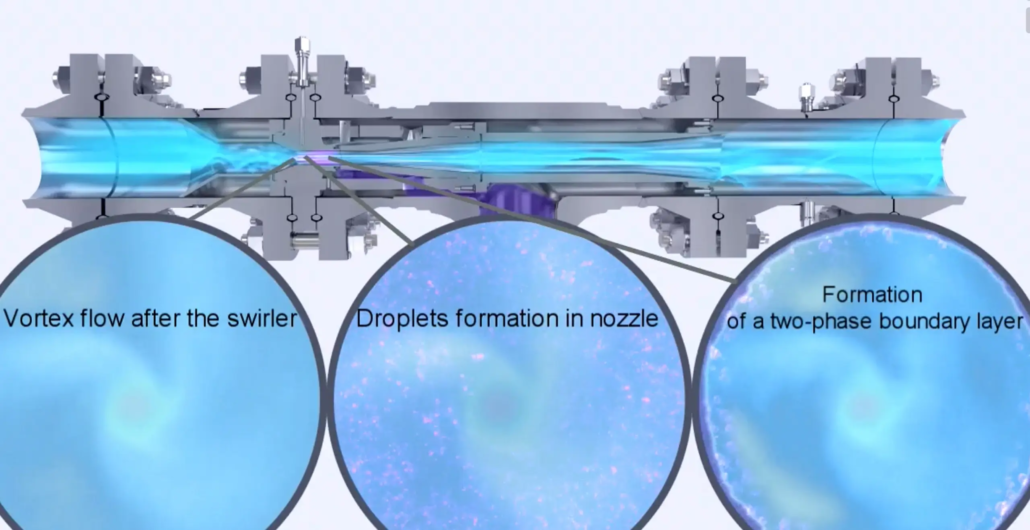
La tecnología de separación supersónica es un método innovador utilizado en el procesamiento de gas natural para separar agua, hidrocarburos pesados y otras impurezas. Este método, impulsado por un flujo supersónico a través de una boquilla de Laval, ofrece varias ventajas sobre técnicas tradicionales como absorción, adsorción y separación por membrana.

SuperSonic Separator - separación supersónica
SuperSonic Separator

El proceso de separación supersónica

En el procesamiento de gas natural, separar impurezas como agua e hidrocarburos pesados es crucial para asegurar la calidad del gas de tubería y mantener su valor calorífico. Los métodos tradicionales como la absorción —que implica materiales de fase sólida como el tri­etileno glicol— y la adsorción —que emplea materiales como gel de sílice— pueden ser complejos y requerir inversiones elevadas. Estos métodos también pueden implicar pérdidas energéticas significativas durante el transporte.

La separación supersónica, sin embargo, ofrece una alternativa más simplificada. El proceso implica que el gas natural pase por una boquilla de Laval, donde se acelera hasta velocidades supersónicas. La rápida expansión del gas produce una caída de temperatura, lo que conduce a la condensación del vapor de agua y los hidrocarburos pesados. Las gotículas resultantes se separan del flujo de gas mediante un separador ciclónico.

Esta técnica presenta varias ventajas. El corto tiempo de residencia dentro del separador evita la formación de hidratos, lo que elimina la necesidad de inhibidores y sistemas de regeneración. Además, el dispositivo es estático, sin partes móviles rotativas, lo que mejora su fiabilidad y lo hace adecuado para operaciones desatendidas, especialmente en plataformas offshore.

Visión estructural del separador supersónico

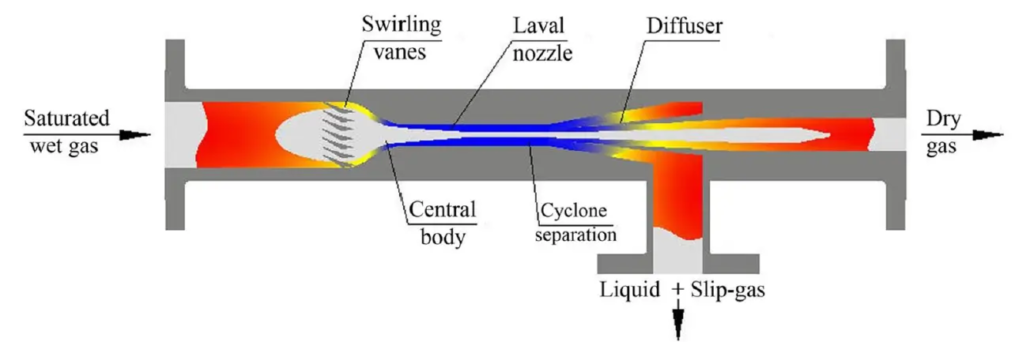
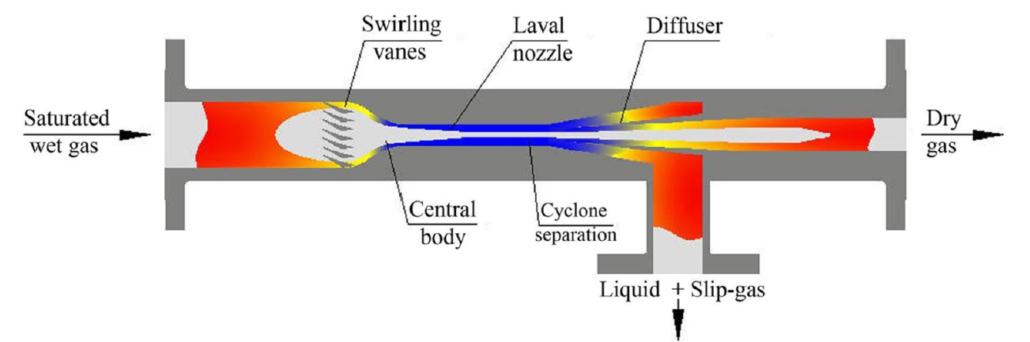
Los separadores supersónicos suelen consistir en una boquilla de Laval, un ciclón y un difusor. Hay dos diseños principales:

  1. Separador con ciclón ubicado detrás: En este diseño, el ciclón se sitúa tras la boquilla de Laval. El flujo es relativamente uniforme, sin ondas de choque significativas, permitiendo una separación eficiente cuando la onda de choque está controlada.
  2. Separador con ciclón ubicado al frente (3S Separator): En este diseño, el ciclón se coloca en la entrada de la boquilla de Laval. Esta configuración asegura que la turbulencia y la condensación del gas ocurran simultáneamente, lo que conduce a una mayor eficiencia de separación y menor re-evaporación de las gotículas.

El diseño de la boquilla de Laval es crucial para asegurar una expansión eficaz del gas y la condensación. Los métodos comunes de diseño de la boquilla incluyen la curva de Witozinsky y la curva paramétrica bicúbica, que aseguran un flujo de aire uniforme y estable.

Marco teórico

El proceso de separación supersónica se basa en los principios de la condensación espontánea, un cambio de fase fuera del equilibrio que ocurre cuando el gas se expande en la boquilla de Laval. El proceso puede dividirse en dos etapas:

  1. Nucleación: A medida que el gas se expande, se vuelve sobresaturado, formando núcleos de condensación. Las gotículas crecen sobre estos núcleos mientras continúan absorbiendo moléculas de vapor del gas circundante.
  2. Crecimiento de gotículas: El crecimiento de las gotículas está gobernado por procesos de transferencia de calor y masa. Las moléculas de vapor se condensan sobre la superficie del núcleo, liberando calor latente, y las gotículas continúan creciendo. Este proceso ocurre a escala microscópica, con diámetros de gotículas típicamente en el rango de nanómetros.

Se han desarrollado varios modelos para simular la nucleación y el crecimiento de gotículas en flujos supersónicos. Estos incluyen la Teoría Clásica de Nucleación (CNT, por sus siglas en inglés) y sus versiones modificadas, como la Teoría de Nucleación Clásica Internamente Consistente (ICCT). Estos modelos, aunque efectivos, a menudo carecen de precisión, especialmente para tener en cuenta el comportamiento de gases reales y el radio de las gotículas.

Investigación y simulación

Las simulaciones numéricas desempeñan un papel crucial en la comprensión del flujo y las características de condensación del gas natural en separadores supersónicos. Los modelos de dinámica de fluidos computacional (CFD) se utilizan para simular el comportamiento del gas dentro de la boquilla de Laval y el separador ciclónico. Estas simulaciones ayudan a optimizar el diseño del separador al analizar factores como los efectos de la presión de entrada, la temperatura y la presencia de impurezas.

Un desafío clave en la separación supersónica es la ocurrencia de ondas de choque, que pueden perturbar el proceso de separación al provocar la re-evaporación de gotículas. Los investigadores han explorado diversas modificaciones de diseño para mitigar este problema, como ajustar el ángulo de expansión de la boquilla y alargar la sección de expansión para mantener un entorno de separación estable.

Los estudios experimentales complementan estas simulaciones. Por ejemplo, la dispersión de luz, la dispersión de rayos X a pequeño ángulo (SAXS) y la espectroscopía de absorción por láser de diodo sintonizable se utilizan para medir los parámetros de condensación en flujos supersónicos. Estos experimentos proporcionan datos valiosos para validar los modelos numéricos.

Aplicaciones en el procesamiento de gas natural

La tecnología de separación supersónica ha demostrado su eficacia en el procesamiento de gas natural, especialmente en la deshidratación y eliminación de hidrocarburos pesados. Las pruebas de campo y las aplicaciones industriales han demostrado su potencial para reemplazar métodos tradicionales en ciertos escenarios.

Por ejemplo, en la última década se han llevado a cabo pruebas de campo donde se utilizaron separadores supersónicos para procesar gas natural en condiciones de alta presión, logrando reducciones significativas en el contenido de agua e hidrocarburos pesados.

También existen numerosos proyectos de 3S Technology entregados con éxito en todo el mundo, donde los separadores 3S han sido instalados resolviendo diversos problemas relacionados con el gas.

Nuevas aplicaciones

La versatilidad de la tecnología de separación supersónica ha llevado a su aplicación en otras áreas del tratamiento de gas natural, incluyendo:

  • Licuefacción de gas natural: Mediante el enfriamiento y licuefacción del gas natural a velocidades supersónicas, esta tecnología tiene el potencial de mejorar la eficiencia de producción de gas natural licuado (GNL). Los investigadores han propuesto procesos de licuefacción de doble etapa utilizando separadores supersónicos para mejorar las tasas de licuefacción.
  • Eliminación de gases ácidos: Los separadores supersónicos también están siendo explorados para eliminar gases ácidos como el dióxido de carbono y el sulfuro de hidrógeno del gas natural. El proceso se basa en la condensación de estos gases a bajas temperaturas y alta presión, seguida de su separación del flujo principal de gas.
  • Purificación de syngas: En modelos teóricos, la separación supersónica ha sido propuesta para la purificación de syngas mediante la eliminación de vapor de agua, dióxido de carbono y otras impurezas.

Direcciones futuras de investigación

Aunque la tecnología de separación supersónica ha mostrado ser prometedora, hay varias áreas para futuras investigaciones:

  1. Modelado y simulación: Los modelos de nucleación actuales necesitan refinamiento, particularmente para tener en cuenta el radio de las gotículas y los efectos de los gases reales. Modelos más precisos mejorarían la predicción de las tasas de condensación y el crecimiento de las gotículas.
  2. Validación experimental: Se necesitan técnicas experimentales más precisas para medir los parámetros de las gotículas, como el tamaño y la distribución, en condiciones supersónicas. Esto permitiría una mejor validación de los modelos numéricos.
  3. Estudios de flujo multifásico: La interacción entre diferentes componentes condensables en mezclas de gas, así como los efectos de impurezas en la condensación, requiere mayor investigación. Son necesarios modelos matemáticos avanzados que tengan en cuenta estas interacciones.
  4. Dinámica de gotículas: El comportamiento de las gotículas en flujos supersónicos —incluyendo su colisión y coalescencia— necesita ser estudiado con mayor detalle. Comprender estos procesos conducirá a diseños de separadores más eficientes.

En conclusión, la tecnología de separación supersónica representa un avance significativo en el procesamiento de gas natural, ofreciendo una alternativa compacta, eficiente y respetuosa con el medio ambiente a los métodos tradicionales. Con el continuo desarrollo e investigación, sus aplicaciones probablemente se expandirán, transformando aún más la industria del gas natural.

In today’s energy market, the demand for efficient, compact, and environmentally friendly gas-treatment technologies has never been higher. Traditional separation methods—based on absorption, adsorption, or cryogenic expansion—often require large equipment, chemicals, and high energy consumption.

The supersonic separator, also called a supersonic gas separator, is a breakthrough solution that changes this paradigm.
By combining the principles of supersonic expansion, rapid cooling, and centrifugal separation, this technology enables dehydration, hydrocarbon dew-point control, acid-gas removal, and NGL recovery in a single compact unit.

Among all current solutions, the 3S supersonic gas separator has emerged as one of the most advanced and widely commercialized systems.
At M-ost Ltd (3S-MOST), we are the official licensee and global manufacturer of 3S technology, providing complete turnkey solutions for NGL recovery, gas conditioning, and CO₂/H₂S extraction to customers worldwide.


🔬 Scientific Basis of Supersonic Gas Separation

1️⃣ Supersonic Expansion and Non-Equilibrium Condensation

The core principle behind a supersonic separator is the rapid expansion of gas through a Laval (converging–diverging) nozzle.
As the gas accelerates to supersonic velocity, static pressure and temperature drop dramatically—sometimes to as low as −50 °C or below.
This sudden cooling induces non-equilibrium condensation of vapors such as water, CO₂, H₂S, and heavy hydrocarbons into fine liquid droplets.

SuperSonic Separator
3S SuperSonic Separator -Laval nozzle

This process happens within milliseconds, making it much faster than conventional chilling or absorption systems. It also avoids hydrate formation due to the extremely short residence time of the gas in the separator.

2️⃣ Swirl Flow and Centrifugal Separation

To separate the condensed droplets from the gas, a swirler or vortex generator imparts a strong rotational motion to the flow.
This creates powerful centrifugal forces—thousands of times greater than gravity—which drive condensed droplets outward toward the walls.
The purified gas moves through the centerline, while the liquid phase is extracted through dedicated drainage ports.

3S SuperSonic gas separator
SuperSonic gas Separator

3️⃣ Energy Efficiency and Compact Design

A diffuser section downstream of the separation zone recovers some of the lost pressure energy, increasing overall efficiency.
Because the system uses the gas’s own expansion energy—not external refrigeration or chemicals—it operates with very low power consumption.
This results in a compact, efficient, and low-maintenance solution ideal for both onshore and offshore gas-processing facilities.


⚙️ Components of a Supersonic Separator

  • Laval Nozzle – accelerates gas to supersonic velocity
  • Swirler (Vortex Generator) – induces strong centrifugal forces
  • Separation Section – condensation and liquid separation zone
  • Diffuser – recovers pressure and stabilizes outlet flow
  • Liquid Collection System – removes condensed phases efficiently

Together, these components perform the entire process—cooling, condensation, and separation—within a single, compact device.


🌍 Key Advantages of Supersonic Separation

Compact and lightweight: Perfect for space-limited sites, including offshore platforms and skid-mounted applications.
Chemical-free operation: No glycol, amine, or other chemicals needed for dehydration or acid-gas removal.
Multi-functional process: Performs dehydration, NGL recovery, and CO₂/H₂S extraction in one unit.
High reliability: No moving parts, minimal maintenance, and simple control.
Fast response: The process is nearly instantaneous; no large inventories of gas or liquid.
Environmentally friendly: Eliminates chemical waste and reduces greenhouse gas emissions.
Cost-effective: Reduced CAPEX and OPEX compared to conventional technologies.


🧠 The 3S Supersonic Gas Separator – Patented & Proven

The 3S supersonic gas separator is a patented technology, recognized for its unique design and performance.
It is protected under international patent filings, including:

These patents cover the fundamental design and operation of the 3S supersonic separator, ensuring global protection and consistent quality.

At M-ost Ltd (3S-MOST), we are the official licensee and worldwide manufacturer of this patented technology.
Every 3S unit is custom-engineered to the client’s feed-gas composition, pressure, temperature, and target separation efficiency.


🏭 Industrial Applications

The 3S supersonic gas separator is versatile and applicable to a broad range of industrial gas processes:

🔹 Gas Conditioning & Enrichment

  • Removes water vapor and heavy hydrocarbons (C₂+, C₃+)
  • Controls gas dew-point to prevent hydrate formation
  • Improves pipeline gas quality and heating value

🔹 NGL Recovery

  • Extracts propane, butane, and heavier hydrocarbons (C₃+ fractions)
  • Reduces the need for bulky cryogenic systems
  • Ideal for onshore plants and offshore platforms

🔹 CO₂ / H₂S / Acid Gas Separation

  • Partially or completely removes acid gases from raw natural gas
  • Can operate standalone or as a pre-treatment before amine/membrane systems
  • Enables cleaner, specification-grade natural gas

🔹 LNG & Cryogenic Pre-Treatment

  • Reduces CO₂ and heavy hydrocarbon content before liquefaction
  • Improves LNG yield and plant efficiency
  • Integrates seamlessly into existing LNG pre-treatment trains

🔹 Offshore & Subsea Gas Processing

  • Compact, lightweight, and low-maintenance
  • Suitable for unmanned or subsea installations
  • Reduces space, weight, and operational risk

🧩 Why Choose 3S-MOST

  • Official 3S licensee and global manufacturer
  • Tailored engineering for specific gas compositions and process goals
  • Compact, modular units ready for plug-and-play installation
  • Proven track record in industrial and offshore environments
  • Global delivery, commissioning, and after-sales support
  • Dedicated inquiry forms for quick and accurate proposals

🟢 Inquiry Forms:


🌐 The Future of Gas Processing is Supersonic

Supersonic gas separation combines advanced fluid dynamics with industrial practicality.
It offers an environmentally responsible and energy-efficient way to treat natural gas while meeting modern operational demands.

The 3S supersonic gas separator, developed under international patents and commercialized globally by M-ost Ltd (3S-MOST), represents the next generation of separation technology—delivering superior performance, low maintenance, and compact design.


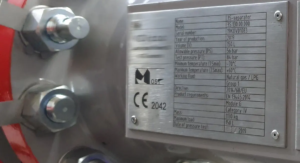
3S CE Certification 2
Supersonic Gas Separation – The Next-Generation Solution for Natural Gas Processing 6

⚡ Get in Touch

Are you ready to bring supersonic efficiency to your gas processing operations?
Contact us today to discuss your project or request a customized 3S supersonic separator proposal.

🔗 Request a 3S Separator Proposal


M-ost Ltd (3S-MOST) — official licensee, manufacturer, and global supplier of the 3S supersonic gas separator technology.
Compact. Efficient. Chemical-free. The future of gas processing is supersonic.

In the evolving landscape of natural gas processing, operators are increasingly challenged to expand throughput without major capital investments in new infrastructure. 3S Technology Debottlenecking — the strategic enhancement of existing facilities — offers a practical and cost-effective solution.

The 3S Technology (Supersonic Separation System) represents a breakthrough in 3S Technology Debottlenecking for low-temperature separation (LTS) units and other gas processing facilities. By integrating a 3S separation module into an existing LTS train, operators can double gas processing capacity while maintaining stable product quality and minimizing energy consumption.


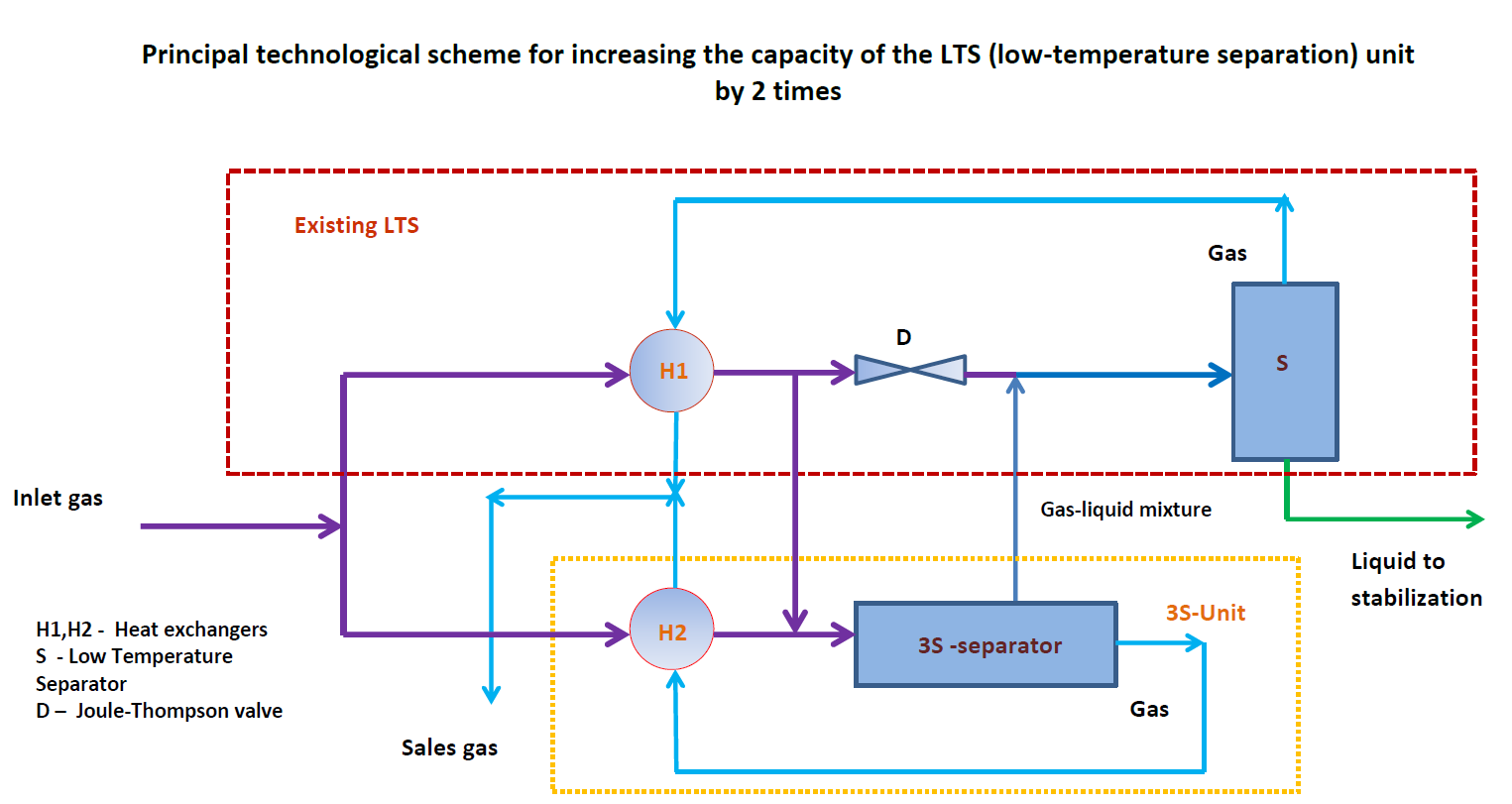
Principal Technological Scheme

Benefits of 3S Technology Debottlenecking

Understanding 3S Technology Debottlenecking

3S Technology Debottlenecking = Principal technological scheme for increasing the capacity of the LTS unit by 2 times using 3S separation technology
If the existing LTS unit is designed for the inlet gas flow rate Q at some Pin and Pout, the application of 3S-separation unit allows to increase the gas flow rate, for example, by 2 times.
The inlet gas flow with a flow rate of 2Q is divided into two equal streams, which are cooled in H1 and H2 respectively; Valve D is closed.
The cooled flow of 2Q and pressure Pin enters the 3S-separator, where it is divided again into 2 equal flows: purified gas and gas-liquid mixture, each of which has a flow rate Q and a pressure Pout.
Some design arrangements of the 3S-separator allows achieving such separation. The purified gas enters the H2 as a cooling agent. The gas-liquid stream is directed to a low-temperature separator S, where it is separated into a gas entering H1, and an unstable liquid.
The unit should also include: an inlet separator, a dehydration unit, and an outlet CS (if necessary).

How It Works

In a conventional LTS unit, gas enters a heat exchanger and is expanded across a Joule–Thomson valve to achieve partial condensation. The resulting gas–liquid mixture is separated in a low-temperature separator. However, capacity expansion is limited by the cooling duty and pressure drop constraints.

With the 3S debottlenecking configuration, the inlet gas flow is divided into two parallel streams, each cooled separately through existing and added heat exchangers (H2 if applicable). The cooled mixture then passes through the 3S separator, where supersonic flow induces high-efficiency phase separation of the gas–liquid stream.

In the Supersonic Gas Separation process, the gas is accelerated through a Laval nozzle, resulting in an adiabatic expansion and cooling that causes heavy hydrocarbons and water to condense. The centrifugal field generated inside the separator efficiently removes the condensed droplets before the gas is recompressed or directed downstream.

The process splits the flow into:

  • Purified gas, directed as a cooling medium through H2;
  • Gas–liquid mixture, sent to the existing LTS separator (S) for final separation.

This arrangement effectively doubles the processing throughput (from Q to 2Q) without major redesign or replacement of core process units.


Advantages of 3S Debottlenecking

  • 2× Capacity Increase — Leverages existing LTS infrastructure with minimal footprint expansion.
  • Improved Efficiency — High-speed supersonic separation enhances phase disengagement and cooling performance.
  • Low Energy Demand — No moving parts or external refrigeration required.
  • Modular Integration — Compact 3S modules can be retrofitted into existing plant layouts.
  • Enhanced Reliability — Reduces hydrate formation risks and stabilizes downstream operations.

Applications Across the Gas Value Chain

3S debottlenecking solutions can be applied across Upstream, Midstream, and Downstream sectors:

  • Upstream: Expanding field-level gas treatment or flared gas recovery systems.
  • Midstream: Increasing plant throughput and preventing hydrate formation during gas conditioning.
  • Downstream: Ensuring steady, high-quality gas supply for petrochemical feedstock and refinery integration.

Additional Research and Knowledge Sources


Conclusion

As the global energy market transitions toward efficiency and sustainability, 3S Technology provides a smart path forward for operators seeking to maximize the potential of existing gas processing assets. By combining compact design, low operational costs, and proven separation performance, 3S-based debottlenecking unlocks significant process capacity — without the cost and complexity of building anew.


Learn more about 3S modular solutions for gas processing, conditioning, and NGL recovery at 3S-MOST.eu.

3S Separator Technology: A Breakthrough in Supersonic Gas Separation


Overview of the 3S Separator

The 3S Separator (SuperSonic Separation) is a revolutionary technology for natural gas and process gas treatment, offering an innovative, highly efficient, and compact solution for gas-liquid and gas-solid separation. Built upon the principle of supersonic expansion, the 3S Separator utilizes advanced fluid dynamics to create extreme thermodynamic conditions, achieving condensation and separation in a single, continuous, and energy-efficient process.

The 3S system offers a new paradigm in gas conditioning, dehydration, and hydrocarbon dew point control, enabling significant operational and economic advantages over conventional technologies such as Joule-Thomson (JT) valves, glycol dehydration, and mechanical separation.


How It Works: The Supersonic Separation Principle

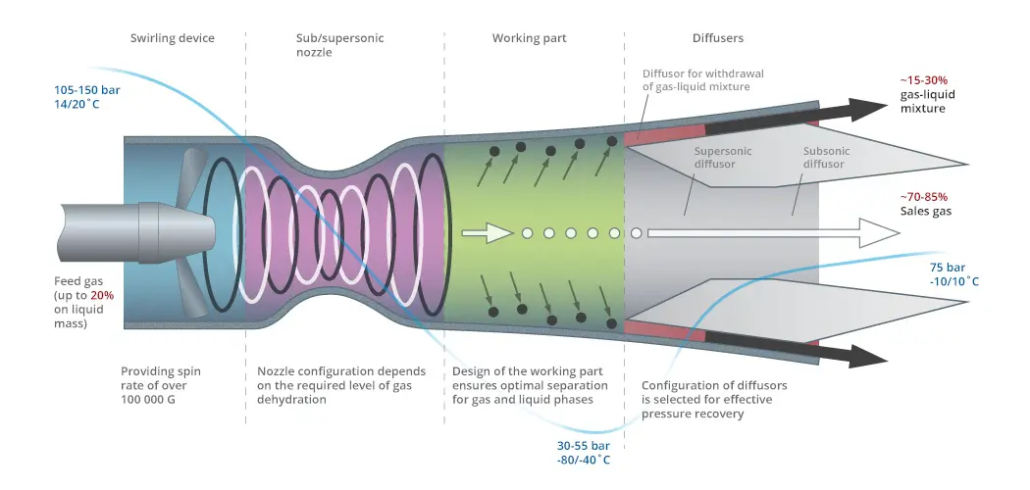
3S separator - working principle
3S Separator Technology: A Breakthrough in Supersonic Gas Separation 11

The 3S Separator operates through a multi-step process:

  1. Acceleration and Expansion: The gas enters a Laval nozzle where it is accelerated to supersonic speeds. This expansion causes a rapid drop in temperature and pressure.
  2. Condensation: Due to the extreme cooling, heavier hydrocarbons, water, and other condensable components form droplets.
  3. Swirling and Separation: A swirl element imparts a high centrifugal force, driving droplets and solid particles to the walls, separating them from the gas stream.
  4. Recompression and Recovery: The lean gas is recompressed, and the separated liquids and solids are extracted downstream.

This sequence occurs in a matter of milliseconds, without moving parts, resulting in highly reliable and low-maintenance operation.

🔗More => 3S separator operating principle


Key Features of the 3S Separator

FeatureDescription
No Moving PartsEnsures high reliability and minimal maintenance.
Compact DesignUp to 70% smaller and lighter than traditional systems.
Energy EfficientUtilizes pressure drop instead of external power for operation.
Modular and ScalableEasily integrated into various system sizes and configurations.
Instantaneous ResponseSeparation occurs in milliseconds, enabling real-time process adjustments.

Typical Applications

Common Uses

  • Natural Gas Processing
  • Pipeline Gas Conditioning
  • Hydrocarbon Dew Point Control
  • Gas Dehydration
  • CO2 and H2S Removal (with upstream cooling and sorbents)
  • NGL (Natural Gas Liquids) Recovery

Process Flow Example – 3S Separator

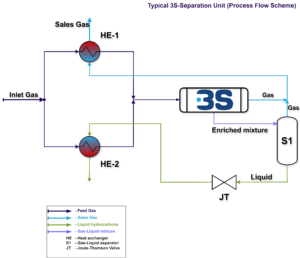
The following schematic outlines a typical 3S Separation Unit:

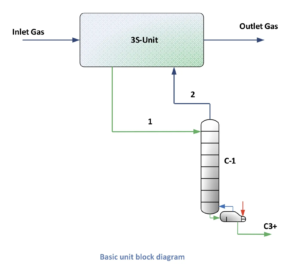
Typical 3S-Separation Unit (Process Flow Scheme)
  1. Feed gas is pre-cooled (if needed).
  2. The gas passes through the Laval nozzle and swirling chamber.
  3. Condensates are removed via a cyclonic separation zone.
  4. Clean, dry, and conditioned gas exits the system.

This layout can be adapted for upstream, midstream, and downstream operations depending on the customer’s process requirements.

🔗More => Standard Process Flow Scheme 3S separator


Benefits of the 3S Technology

BenefitImpact
Enhanced Gas QualityDelivers pipeline-spec or sales-grade gas without additional treatment.
Lower Operational CostsNo chemical reagents, heaters, or compressors needed downstream.
Increased Liquid RecoveryHigh efficiency in NGL and condensate separation.
Environmental ComplianceReduced emissions and zero venting possible.
Fast ROILower CAPEX and OPEX with short payback periods.
Minimal FootprintIdeal for offshore platforms, FPSOs, and remote installations.

Comparing Technologies

Technology Comparison

TechnologyLogo 3S gas teh 3
3S Separator
JT ValveGlycol DehydrationMechanical Separator
Moving PartsNoNoYesYes
FootprintSmallMediumLargeMedium
Energy RequirementLowMediumHighMedium
Separation EfficiencyHighMediumHigh (dehydration)Low
Liquid RecoveryHighMediumLowLow
Environmental ImpactLowMediumHigh (chemicals)Medium

Why Choose 3S Technology?

The 3S Separator is a proven and field-tested solution designed for modern energy systems. Whether your goal is to maximize liquid recovery, meet pipeline specs, reduce operating costs, or increase process efficiency, the 3S system provides a powerful alternative to legacy technologies.

With multiple units successfully operating in harsh environments and across diverse applications, the 3S solution is ready to meet the challenges of the evolving energy landscape.

More => 3S separator & 3S technology projects world wide


Contact and Integration Support

3S offers comprehensive engineering support, from feasibility studies to full integration into existing or new gas processing systems.

To learn more about how the 3S Separator can enhance your operations, contact our team or visit:

For more information on how the 3S Separator can improve your operations, get in touch with our team or visit:

🔗 www.3s-most.eu
🔗3S Separator – Inquiry Form